
Hot flashes may be the symptom everyone associates with menopause.
But the hormonal transition affects much more than body temperature.
Sleep can change. Vaginal dryness may appear. Sex may become uncomfortable. Some women notice changes in mood, concentration, libido, or urinary symptoms. Others reach menopause with surprisingly few symptoms at all.
So what is actually happening hormonally?
And how is menopause different from the years of hormonal fluctuation that come before it?
Learn more about personalized hormone care for perimenopause, menopause, low testosterone, low libido, sleep changes, fatigue, and body-composition concerns.
Explore Hormone CareFirst: What Does “Menopause” Actually Mean?
Menopause is technically one point in time: it is reached after 12 consecutive months without a menstrual period when there is no other explanation for the absence of periods.
The years leading up to that point are called perimenopause.
And the years afterward are postmenopause.
That distinction matters because your hormones behave differently during each stage.
During perimenopause, estrogen can fluctuate significantly and ovulation becomes less predictable.
After menopause, ovarian function has changed more permanently.
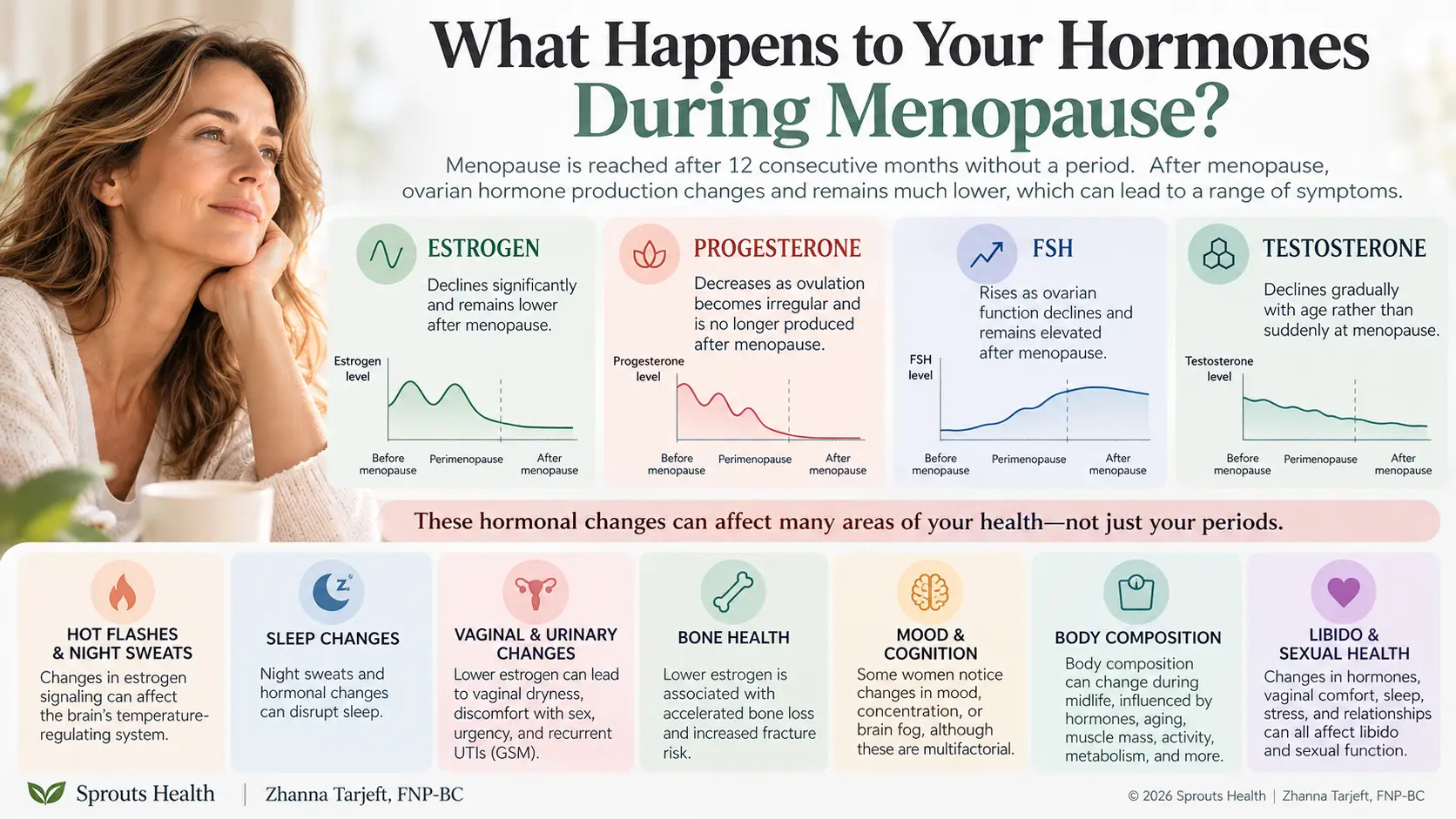
What Happens to Estrogen After Menopause?
Before menopause, the ovaries are the body’s major source of estradiol.
During perimenopause, estradiol production can be unpredictable—sometimes relatively high and sometimes low.
After menopause, ovarian estradiol production declines substantially and remains much lower.
This lower estrogen environment contributes to several of the changes associated with menopause.
Hot flashes and night sweats
Changes in estrogen signaling affect the brain’s temperature-regulating system.
The result can be sudden sensations of heat, sweating, flushing, and sometimes chills afterward.
These are known as vasomotor symptoms, and they are among the most common symptoms of the menopause transition.
They can also disrupt sleep—especially when night sweats repeatedly wake you.
The Menopause Society identifies hot flashes, vaginal dryness, sleep disturbances, and mood changes among the commonly experienced symptoms and changes associated with menopause.
Vaginal and urinary changes
Estrogen also plays an important role in maintaining the tissues of the vagina, vulva, urethra, and bladder.
As estrogen declines, some women develop:
- vaginal dryness
- burning or irritation
- discomfort or pain during sex
- urinary urgency or frequency
- recurrent urinary tract infections
Collectively, these changes are known as genitourinary syndrome of menopause (GSM).
Unlike hot flashes, which often improve with time, vaginal and urinary symptoms may persist or worsen without treatment.
What Happens to Progesterone?
Progesterone is primarily produced after ovulation by the corpus luteum.
As ovulation becomes increasingly inconsistent during late perimenopause, progesterone exposure becomes less predictable.
Once menopause has occurred and ovulation has stopped, the ovaries no longer produce meaningful cyclical progesterone.
That does not mean every symptom after menopause is caused by “low progesterone.”
Sleep changes, mood symptoms, weight changes, anxiety, and cognitive concerns can have multiple contributing factors.
This distinction matters because symptoms shouldn’t automatically be assigned to one hormone simply because that hormone has declined.
What Happens to FSH?
As ovarian follicles become depleted and ovarian responsiveness declines, the feedback signals between the ovaries and pituitary gland change.
As a result, follicle-stimulating hormone (FSH) rises.
After menopause, FSH typically remains elevated compared with reproductive-age levels.
But in a woman over 45 with a typical menstrual history and symptoms, menopause usually does not need to be “proven” by repeatedly measuring FSH.
Hormone levels are only one piece of the clinical picture.
What About Testosterone?
This is where menopause discussions often become oversimplified.
Women absolutely produce testosterone.
But testosterone does not suddenly disappear at menopause.
And unlike estrogen and progesterone, the decline in testosterone is more closely associated with aging over time than with the final menstrual period itself. The Menopause Society specifically cautions against describing testosterone as a hormone that simply needs to be routinely “replaced” after menopause.
That doesn’t mean testosterone is irrelevant.
Sexual desire and function can change during midlife, but they are influenced by many factors—including estrogen status, vaginal discomfort, sleep, medications, relationships, stress, health conditions, and androgen activity.
Testosterone therapy has a much narrower evidence-based indication than estrogen therapy. Current consensus supports its use for appropriately evaluated postmenopausal women with hypoactive sexual desire disorder (HSDD) rather than as a general treatment for fatigue, weight gain, aging, or “hormone optimization.”
Why Does Menopause Affect So Many Parts of the Body?
Estrogen receptors are found throughout the body.
So changes in estrogen signaling aren’t limited to the reproductive system.
The menopause transition can be associated with changes involving:
Temperature regulation
Hot flashes and night sweats are classic examples.
Sleep
Night sweats can disrupt sleep directly, although not every sleep problem in midlife is hormonal.
Vaginal and urinary tissues
Lower estrogen can lead to GSM.
Bone
Estrogen plays an important role in maintaining bone density. Bone loss accelerates around the menopause transition.
Mood and cognition
Some women report mood changes, difficulty concentrating, or subjective “brain fog” during the menopause transition, although these symptoms are multifactorial and should not automatically be attributed to estrogen deficiency alone.
This is why menopause can feel very different from simply “not having periods anymore.”
What About Weight Gain and Belly Fat?
This deserves special attention because menopause often gets blamed for every change in body composition.
Midlife body composition can change.
But it is more complicated than:
low estrogen = weight gain.
Aging, loss of lean muscle mass, activity, sleep, diet, insulin sensitivity, medications, genetics, and hormonal changes can all contribute.
Menopause may influence fat distribution, including a greater tendency toward central adiposity, but hormone therapy should not be prescribed primarily as a weight-loss treatment.
The Menopause Society specifically advises against using estrogen-containing hormone therapy to treat primarily age-related changes such as weight gain.
That doesn’t mean body-composition concerns should be dismissed.
It means they deserve a broader evaluation rather than automatically increasing someone’s hormone dose.
Not Every Symptom After 45 Is Menopause
This is one of the most important principles in good menopause care.
Fatigue can occur during menopause.
But fatigue can also occur with iron deficiency, thyroid dysfunction, sleep apnea, insufficient sleep, medication effects, depression, inadequate nutrition, and many other conditions.
Hair loss may happen around midlife—but it isn’t automatically estrogen deficiency.
Weight changes aren’t automatically a hormone deficiency.
Poor sleep isn’t always progesterone.
Low libido isn’t always testosterone.
A thoughtful evaluation asks:
Which symptoms fit the menopause transition, and which ones suggest that something else may also be contributing?
That is where thyroid function, iron status, metabolic health, medications, sleep, nutrition, and other factors may become relevant.
Do You Need Hormone Therapy After Menopause?
Not every woman does.
Some women have mild symptoms and don’t want treatment.
Others have symptoms that substantially affect sleep, work, relationships, sexual health, or quality of life.
Treatment should be based on symptoms, medical history, individual risks, preferences, age, and time since menopause—not simply on reaching a particular hormone level.
For women who are appropriate candidates, menopausal hormone therapy remains the most effective treatment for bothersome hot flashes and night sweats and is also effective for genitourinary symptoms. It also prevents bone loss and reduces fracture risk.
Estrogen Isn’t the Same Treatment for Every Woman
Hormone therapy isn’t one medication or one protocol.
Estrogen can be delivered systemically through options such as:
- patches
- gels or sprays
- oral tablets
- certain vaginal rings
Low-dose vaginal estrogen is different from systemic estrogen and can be used specifically for vaginal and urinary symptoms.
Route matters.
The appropriate choice depends on the woman’s symptoms, medical history, risk factors, preferences, and treatment goals.
What About Progesterone With Estrogen?
This is another place where treatment should be precise.
If you still have your uterus and use systemic estrogen, adequate endometrial protection is generally necessary. But even without uterus, progesterone could be beneficial for other symptoms.
That usually means adding a progestogen, such as micronized progesterone, to reduce the risk of endometrial hyperplasia and cancer from unopposed systemic estrogen.
What If You Can’t—or Don’t Want to—Use Hormones?
Hormone therapy isn’t the only option.
There are evidence-based nonhormonal treatments for vasomotor symptoms, and vaginal symptoms can be treated with several hormonal and nonhormonal approaches.
Treatment should match the symptom you’re actually trying to treat.
For some women, lifestyle measures are sufficient.
For others, prescription treatment makes a meaningful difference.
There isn’t one correct menopause treatment for every woman.
The Takeaway
Menopause isn’t simply the moment your periods stop.
It represents a major change in ovarian function.
After menopause:
Estrogen production from the ovaries becomes much lower.
Ovulation stops.
Cyclical progesterone production ends.
FSH remains elevated.
Testosterone continues its more gradual age-related trajectory rather than suddenly disappearing.
These changes can contribute to hot flashes, night sweats, vaginal and urinary symptoms, sleep disruption, bone loss, and other changes associated with the menopause transition.
But menopause shouldn’t become an explanation for every symptom that develops in midlife.
The goal of good menopause care isn’t to chase “optimal” hormone numbers or automatically replace every hormone that has declined.
It’s to identify which symptoms are likely hormone-related, rule out important contributors when appropriate, and choose treatment based on your individual benefits, risks, and goals.
If hot flashes, sleep changes, vaginal symptoms, libido changes, or other midlife symptoms are affecting how you feel, start with a personalized evaluation of your symptoms, history, and treatment options.
Book Your Clarity Session© 2020-2026 Sprouts Health, LLC. All rights reserved. Privacy Policy | Medical Disclaimer | Notice of Privacy Practices