
“Bioidentical hormones” may be one of the most misunderstood terms in menopause care.
Some women have been told that bioidentical hormones are natural, while conventional hormone therapy is synthetic.
Others assume that if a prescription comes from a compounding pharmacy, it must be bioidentical—and if it comes from a regular pharmacy, it isn’t.
Neither is necessarily true.
Some FDA-approved hormone therapies are bioidentical too.
And hormone therapy is about much more than simply choosing something labeled “natural.”
The better questions are:
Which hormone are we using? How is it delivered? What are we trying to treat? What benefits might it provide? And what are the individual risks for the woman taking it?
Let’s break it down.
What Does “Bioidentical” Actually Mean?
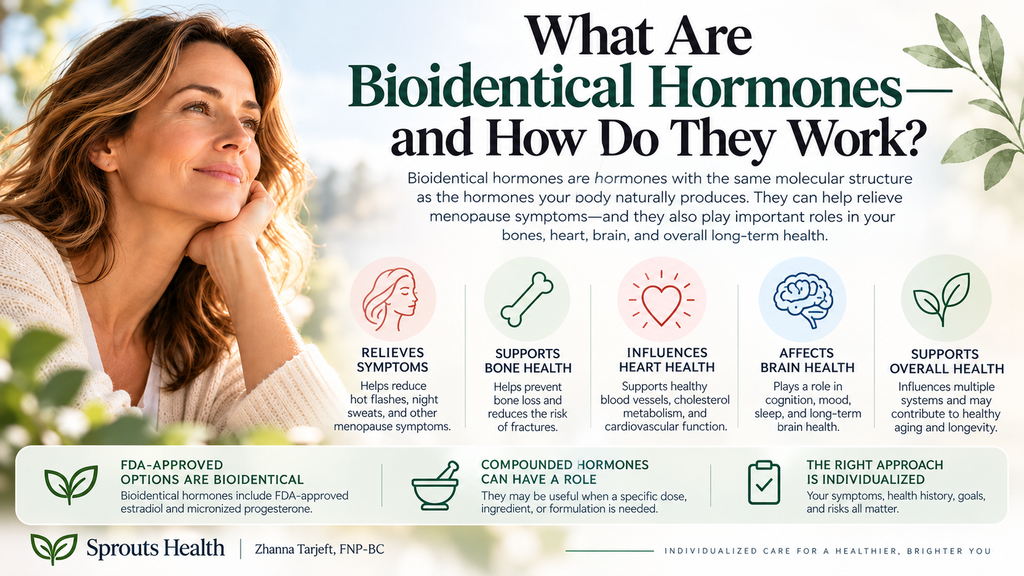
A bioidentical hormone has the same molecular structure as the corresponding hormone produced by the human body.
Two important examples in menopause care are:
17β-estradiol — structurally identical to endogenous estradiol.
Micronized progesterone — structurally identical to endogenous progesterone.
These hormones may be manufactured using plant-derived starting materials, but once manufactured, it is their molecular structure—not simply their plant origin—that makes them bioidentical.
And here’s the part many women don’t realize:
Bioidentical does not mean compounded.
FDA-approved estradiol and micronized progesterone products are available and are considered bioidentical hormones.
Bioidentical Doesn’t Mean “Natural” in the Way Most People Think
The word natural can be misleading.
Estradiol used in hormone therapy isn’t simply extracted from a plant and placed into a patch or cream.
Plant-derived compounds are processed to produce hormones with the desired molecular structure.
That’s why I don’t find the question:
“Is this hormone natural?”
nearly as useful as:
What hormone is it?
What is its molecular structure?
What dose are we using?
How is it being delivered?
What are we hoping to accomplish with treatment?
Those questions tell us much more about hormone therapy than the word natural ever could.
Bioidentical Hormones Can Be FDA-Approved
This surprises many women.
FDA-approved bioidentical hormone therapy includes formulations containing estradiol and micronized progesterone.
Estradiol is available in several forms, including patches, gels, sprays, oral tablets, and vaginal preparations.
Micronized progesterone is also available as an FDA-approved oral medication.
These products undergo FDA review for manufacturing quality, potency, pharmacokinetics, safety, and effectiveness for their approved indications.
So a woman can absolutely receive bioidentical menopausal hormone therapy without using compounded hormones.
Then What Are Compounded Bioidentical Hormones?
Compounded hormones are medications prepared by a compounding pharmacy for an individual prescription.
They may contain:
- estradiol
- progesterone
- testosterone
- estriol
- or combinations of hormones
Compounding itself isn’t inherently bad.
There are situations in medicine where it can be genuinely useful.
For example, a woman may need a dose that isn’t commercially available, may be unable to tolerate an ingredient in a commercial product, or may need a formulation that isn’t otherwise available.
But compounded and bioidentical are not synonyms.
An FDA-approved estradiol patch contains bioidentical estradiol.
A compounded estradiol cream can also contain bioidentical estradiol.
The difference is primarily in how the medication is manufactured, standardized, tested, and regulated—not whether the estradiol molecule somehow becomes more natural because it came from a compounding pharmacy.
Are Compounded Hormones Better Because They’re Customized?
Personalized hormone care absolutely matters.
But personalized care doesn’t necessarily require a custom-compounded medication.
Treatment can be individualized by changing:
- the hormone
- dose
- route
- timing
- progesterone regimen
- treatment goals
- monitoring
- adjustments based on symptoms and side effects
using FDA-approved medications.
Compounding can provide additional options when commercially available products don’t meet an individual woman’s needs.
However, compounded products don’t undergo the same FDA premarket review for safety, effectiveness, potency, and manufacturing consistency as FDA-approved medications.
For that reason, ACOG recommends FDA-approved menopausal hormone therapies when appropriate products are available.
“Customized” doesn’t automatically mean safer, more effective, or better.
Learn more about personalized hormone care for perimenopause, menopause, low testosterone, low libido, sleep changes, fatigue, and body-composition concerns.
Explore Hormone CareHow Does Bioidentical Estradiol Work?
Estradiol is the predominant estrogen during the reproductive years.
During perimenopause, estradiol can fluctuate dramatically.
After menopause, ovarian estradiol production becomes much lower.
Estradiol binds to estrogen receptors throughout the body.
And those receptors aren’t found only in the uterus and breasts.
Estrogen receptors are present in the brain, bones, blood vessels, genitourinary tissues, and many other parts of the body.
That’s why menopause isn’t simply about periods stopping.
And it’s why estrogen therapy can affect much more than hot flashes.
Estrogen Does More Than Treat Hot Flashes
Estrogen is frequently discussed as though its primary purpose after menopause is symptom relief.
Certainly, systemic estrogen is highly effective for treating hot flashes and night sweats.
But estrogen biology extends well beyond vasomotor symptoms.
This is an area explored extensively by Dr. Avrum Bluming and Carol Tavris in the updated edition of Estrogen Matters, which reviews research concerning estrogen and bone, cardiovascular health, brain health, and longevity.
Some of these benefits are extremely well established.
Others remain more controversial or are supported predominantly by observational rather than randomized evidence.
I think women deserve to hear about both.
Estrogen and Bone: The Evidence Is Strong
This is one area where there is very little controversy.
Estrogen plays a major role in maintaining bone.
When estrogen declines around menopause, bone resorption accelerates and women can lose bone more rapidly.
That matters because declining bone density increases the future risk of osteoporosis and fractures.
Systemic menopausal hormone therapy has been shown to:
reduce bone loss
and
reduce fracture risk.
The Menopause Society recognizes prevention of bone loss and fracture as an established benefit of menopausal hormone therapy.
So when we discuss estrogen therapy, we’re not simply talking about making hot flashes disappear.
Estrogen has a very real effect on skeletal health.
What About Estrogen and the Heart?
This is where the story becomes much more interesting.
Estrogen affects vascular function, lipid metabolism, inflammation, and other cardiovascular pathways.
For decades, observational research suggested that women using menopausal hormone therapy had lower rates of coronary heart disease.
Then came the Women’s Health Initiative, and the public message abruptly became:
“Hormones cause heart disease.”
The actual story turned out to be considerably more complicated.
The population studied, age of participants, hormone formulations used, baseline cardiovascular health, and interpretation of relative versus absolute risks all matter.
The revised edition of Estrogen Matters examines this history in detail and argues that the cardiovascular benefits of estrogen have been substantially underestimated.
Current menopause organizations are more cautious about calling estrogen a cardiovascular-prevention therapy.
But they also don’t support the simplistic idea that menopausal hormone therapy is inherently harmful to the heart.
The British Menopause Society, for example, states that HRT initiated before age 60 or within 10 years of menopause is likely associated with reductions in coronary heart disease and cardiovascular mortality. It also supports individualized treatment in older women rather than imposing an arbitrary age cutoff.
So I don’t tell women:
“Take estrogen so you don’t have a heart attack.”
But I also don’t think the cardiovascular research surrounding estrogen should be ignored.
The better conversation is about the woman’s overall cardiovascular health, hormone formulation, route, dose, and individual risk profile.
What About Estrogen and the Brain?
The brain is also an estrogen-responsive organ.
Estrogen receptors are present in areas involved in:
- memory
- cognition
- mood
- temperature regulation
- sleep
- neurochemical signaling
Researchers have therefore spent decades studying whether estrogen exposure around and after menopause influences cognitive aging and dementia.
There are biologically plausible mechanisms and observational data suggesting potential neuroprotective effects of estrogen.
Estrogen Matters devotes substantial attention to the relationship between estrogen and Alzheimer’s disease and argues that the total body of evidence deserves greater consideration than it received after the initial WHI messaging.
At the same time, current major menopause guidelines do not recommend systemic hormone therapy solely for the purpose of preventing Alzheimer’s disease or dementia. The Menopause Society continues to regard dementia risk as part of the individualized benefit-risk assessment.
So I would not promise a woman:
“Estrogen will prevent Alzheimer’s disease.”
We don’t have evidence strong enough to make that promise.
But I also wouldn’t say:
“Estrogen has nothing to do with the brain.”
That would ignore an enormous amount of physiology and ongoing research.
The brain is an estrogen-responsive organ, and the relationship between estrogen and long-term brain health remains an important area of research.
What About Longevity?
This may be one of the most fascinating—and easiest to overstate—areas of hormone research.
Some observational studies and follow-up analyses have associated menopausal hormone therapy with favorable long-term health outcomes and lower mortality in certain populations.
Bluming and Tavris devote considerable attention to this literature in Estrogen Matters, including research involving estrogen, cardiovascular disease, bone health, cognition, and longevity.
But I wouldn’t tell a woman:
“Hormone therapy will make you live longer.”
That’s a much stronger claim than the evidence allows us to make for an individual patient.
I would say something different:
Estrogen affects multiple biological systems that influence long-term health, and the potential effects of menopausal hormone therapy extend beyond symptom control.
Some benefits—especially bone protection—are firmly established.
Others, including cardiovascular, cognitive, and longevity effects, remain areas where research continues to evolve.
There Isn’t a Universal Expiration Date for Hormone Therapy
One misconception I don’t want women walking away with is:
“If I didn’t start hormones within 10 years of menopause, I missed my chance.”
That’s too simplistic.
Age and years since menopause are relevant pieces of the risk assessment, but they aren’t the only factors that determine whether hormone therapy is appropriate.
The British Menopause Society explicitly states that arbitrary limits should not be placed on the duration of HRT and provides recommendations for initiating or continuing treatment in women over 60 using individualized assessment and, where appropriate, lower-dose and transdermal approaches.
That doesn’t mean age or timing are irrelevant.
It means 10 years isn’t an automatic expiration date.
The decision should consider the woman in front of us:
her cardiovascular health,
her thrombotic risk,
her breast and uterine history,
her bone health,
her symptoms,
her treatment goals,
the hormone formulation,
the route,
and the dose.
That’s a much more useful conversation than simply counting years since her last period.
Does the Route of Estradiol Matter?
Yes.
Estradiol can be delivered through several routes.
Transdermal estradiol can be delivered through a patch, gel, or spray.
Oral estradiol is taken by mouth.
Vaginal estrogen can be delivered through creams, tablets, inserts, or certain rings, depending on the treatment goal.
The route affects how estrogen is absorbed and metabolized.
Oral estrogen undergoes first-pass metabolism through the liver.
Transdermal estradiol largely bypasses first-pass hepatic metabolism.
The British Menopause Society notes that transdermal estradiol is unlikely to increase venous thrombosis or stroke risk above that of nonusers and recommends it preferentially in women with relevant risk factors.
That’s why I don’t think of hormone therapy simply as:
“Are you taking estrogen?”
The better question is:
Which estrogen, at what dose, through which route, for what reason?
What Does Bioidentical Progesterone Do?
Progesterone is another hormone whose role is often reduced to one sentence:
“You need progesterone to protect the uterus if you take estrogen.”
That’s true—but it’s not the whole story.
Before menopause, progesterone is primarily produced after ovulation. As ovulation becomes less consistent during perimenopause, progesterone exposure becomes less predictable. After menopause, cyclical ovarian progesterone production essentially ends.
When a woman has a uterus and uses systemic estrogen, one of progesterone’s most important roles is endometrial protection. Adequate progesterone prevents estrogen from continuously stimulating the uterine lining and reduces the risk of endometrial hyperplasia and cancer.
But progesterone also has effects outside the uterus.
Progesterone and Sleep
This is probably the best-supported additional benefit of oral micronized progesterone.
When oral micronized progesterone is metabolized, it produces neuroactive metabolites including allopregnanolone. Allopregnanolone interacts with GABA-A receptors in the brain—the same inhibitory signaling system involved in relaxation and sleep.
That is one reason oral micronized progesterone can cause sleepiness and is commonly taken at bedtime.
A systematic review of randomized controlled trials found that micronized progesterone improved several sleep outcomes, with the strongest pooled evidence for improvement in sleep-onset latency. Self-reported sleep improved in most of the included trials, although the studies were relatively small and not every objective sleep measure improved.
The British Menopause Society also recognizes the sleep-promoting effects of oral micronized progesterone and notes that this effect appears to be related to its conversion to allopregnanolone.
So even in a woman who has had a hysterectomy and doesn’t require progesterone for uterine protection, there may be situations where oral micronized progesterone is considered because of its effects on sleep.
Progesterone and Hot Flashes or Night Sweats
Progesterone may also have activity against vasomotor symptoms.
In a randomized placebo-controlled trial of healthy postmenopausal women, oral micronized progesterone at bedtime significantly reduced hot-flash and night-sweat scores compared with placebo.
The evidence base is much smaller than it is for estrogen, so I wouldn’t present progesterone as equivalent to estrogen for treating vasomotor symptoms.
But it is interesting because it demonstrates that progesterone itself has physiologic effects in menopause independent of protecting the endometrium.
What About Mood, Anxiety, and the Brain?
This area is more complicated.
Progesterone and its metabolites interact with the central nervous system, particularly through neurosteroid pathways involving GABA-A receptors.
That gives progesterone biologic plausibility for effects involving calm, sleep, mood, and stress response.
Some women describe feeling calmer or sleeping much better on micronized progesterone. Others experience the opposite—sedation, dizziness, low mood, or simply not feeling well on it.
Research into progesterone’s effects on mood, cognition, and anxiety is considerably less established than its role in endometrial protection, and I wouldn’t promise these as predictable treatment benefits. Reviews of the literature have found intriguing findings but also substantial limitations in study quality and size.
Again, this is an area where individual response matters.
Progesterone Is Not the Same as Every Progestogen
This distinction is important.
Micronized progesterone is molecularly identical to the progesterone produced by the ovaries.
Synthetic progestogens—often called progestins—are different molecules that also activate progesterone receptors but can have different pharmacologic and metabolic effects.
We shouldn’t automatically assume that findings from one progestogen apply equally to every other one.
For example, observational evidence suggests that micronized progesterone may have a more favorable profile for venous thromboembolism and possibly breast cancer risk compared with some synthetic progestogens, although these differences shouldn’t be overstated and more long-term data are needed. The British Menopause Society specifically recognizes these potential differences.
Do You Need Progesterone if You Don’t Have a Uterus?
Not necessarily—but “you don’t have a uterus, so progesterone has absolutely no purpose” is also too simplistic.
After hysterectomy, progesterone is generally not required solely to protect the endometrium, because there is no endometrium to protect.
For many women using estrogen after hysterectomy, estrogen alone may therefore be entirely appropriate.
But in selected women, micronized progesterone may still be considered for other clinical reasons—particularly when sleep disturbance is a significant concern, and potentially in some women with vasomotor symptoms.
The decision should be based on the woman’s symptoms, response, risks, and treatment goals rather than assuming every woman either automatically needs progesterone or automatically has no reason to use it.
Progesterone is more than simply the hormone we add to estrogen to protect the uterus. It is also a neuroactive hormone with effects of its own.
That last sentence is the one I’d keep bold in the article. It gets across exactly what you’re trying to say without claiming that every woman after hysterectomy should automatically receive progesterone.
What Does “Balancing Your Hormones” Actually Mean?
This phrase is everywhere.
But I don’t believe the goal of hormone therapy should be to make every hormone land on a predetermined “optimal” number.
We’re not trying to recreate the exact hormonal profile of a 25-year-old woman.
Instead, treatment should have a purpose.
Are hot flashes improving?
Is she sleeping better?
Has vaginal discomfort improved?
How does she feel?
Are there side effects?
Is the endometrium adequately protected when systemic estrogen is used?
Is treatment supporting bone health where that is part of the clinical goal?
And does the overall benefit continue to outweigh the risk for this particular woman?
That’s much more meaningful than chasing a perfect hormone number.
Do You Need Hormone Testing to Use Bioidentical Hormones?
Usually, not in the way many women have been led to believe.
For women with a typical menopause transition, treatment generally doesn’t require repeatedly measuring estrogen and progesterone to determine whether the hormones are “balanced.”
Symptoms, menstrual history, health history, treatment response, and individual risk factors often provide more useful information.
Testing can absolutely be appropriate when there is a specific clinical question.
That’s different from repeatedly measuring hormones simply to adjust doses toward an arbitrary “optimal” laboratory range.
And saliva testing isn’t considered a reliable way to customize menopausal hormone therapy. ACOG notes that evidence supporting adjunct hormone testing for dosing compounded menopausal hormone therapy is limited and does not recommend routine use for this purpose.
What About Estriol?
Estriol is another estrogen frequently included in compounded “bioidentical” hormone preparations.
It is sometimes described as a “weak estrogen” and therefore assumed to be safer.
But weaker does not automatically mean safer.
Estriol-containing compounded formulations haven’t undergone the same FDA approval process as commercially approved estradiol medications.
Again, the word bioidentical alone doesn’t tell us whether something is safer or more effective.
What About Testosterone?
Testosterone is naturally present in women too.
And it deserves its own conversation.
There is currently no FDA-approved systemic testosterone formulation specifically designed for women in the United States.
The strongest clinical-trial evidence for testosterone therapy in women involves sexual desire and HSDD.
But as I discuss in my testosterone article, some women taking testosterone also report improvements in energy, motivation, cognition, exercise response, strength, and overall well-being.
Those experiences shouldn’t be dismissed.
At the same time, they shouldn’t be promised as established benefits when the research is incomplete.
We don’t need to choose between listening to women and practicing evidence-based medicine. We can do both.
Are Bioidentical Hormones Safer?
The word bioidentical itself does not establish safety.
Risk depends on many things:
- which hormone is being used
- dose
- route of administration
- whether a woman has a uterus
- age and overall health
- cardiovascular risk
- thrombotic risk
- breast and uterine history
- duration of treatment
- other medical conditions
And different hormone formulations shouldn’t automatically be grouped together.
Oral estrogen and transdermal estradiol don’t have identical metabolic effects.
Micronized progesterone and synthetic progestins aren’t identical molecules either.
The British Menopause Society notes observational evidence suggesting that micronized progesterone and dydrogesterone may have more favorable venous-thrombosis and breast-risk profiles than some other progestogens, although differences in breast-cancer risk are small, particularly in the short term.
So when women hear:
“Hormone therapy is dangerous.”
or
“Bioidentical hormones are completely safe.”
both statements are far too simplistic.
Bioidentical vs. Synthetic Isn’t the Most Useful Question
This may be the biggest misconception I want women to take away from this article.
Instead of asking:
Bioidentical or synthetic?
I’d rather ask:
Estradiol or another estrogen?
Micronized progesterone or another progestogen?
Oral or transdermal?
Systemic or local?
FDA-approved or compounded?
What dose?
For which symptoms or health goals?
What are this woman’s individual benefits and risks?
Those questions actually help us make treatment decisions.
The marketing label doesn’t.
So Are Bioidentical Hormones Right for You?
Maybe.
But “I want bioidentical hormones” isn’t enough information to design a treatment plan.
First, we need to understand what you’re trying to accomplish.
A woman whose primary concern is severe hot flashes may need a very different approach from a woman whose primary concern is vaginal dryness.
A woman concerned about declining bone density may have different treatment considerations.
A woman with a uterus using systemic estrogen generally needs adequate endometrial protection.
Another woman may have medical factors that change the risk-benefit discussion.
And some women may decide they don’t want hormone therapy at all.
There isn’t one perfect hormone protocol for every woman.
The Takeaway
Bioidentical hormones aren’t a special category of “natural” hormones available only through compounding pharmacies.
They are hormones with molecular structures identical to hormones produced by the human body.
And some of the most commonly used bioidentical hormones—17β-estradiol and micronized progesterone—are available as FDA-approved prescription medications.
Compounded hormones can have an important role when commercially available options don’t adequately meet an individual patient’s needs.
But compounded doesn’t automatically mean:
more natural
safer
more effective
or
more personalized.
And FDA-approved doesn’t mean a hormone isn’t bioidentical.
Hormone therapy also isn’t only about symptom control.
Estrogen has important effects on bone, cardiovascular, brain, and genitourinary physiology. Its ability to prevent bone loss and fractures is well established. Research examining cardiovascular health, cognition, and longevity is more nuanced and continues to evolve. The 2024 revision of Estrogen Matters specifically examines this broader body of research.
There also isn’t a universal expiration date after which every woman suddenly becomes inappropriate for hormone therapy. Age and years since menopause belong in the risk assessment, but so do her overall health, medical history, formulation, route, dose, symptoms, goals, and preferences.
Ultimately, I care much less about the marketing label and much more about this:
Are we choosing the right hormone, in the right formulation and dose, for the right woman—and are we using it for a clear clinical reason?
That’s what individualized hormone care should actually mean.
Hormone therapy isn’t one-size-fits-all. Your symptoms, health history, stage of menopause, treatment goals, and individual risk factors all matter when choosing the right approach.
Book Your Clarity Session© 2020-2026 Sprouts Health, LLC. All rights reserved. Privacy Policy | Medical Disclaimer | Notice of Privacy Practices