
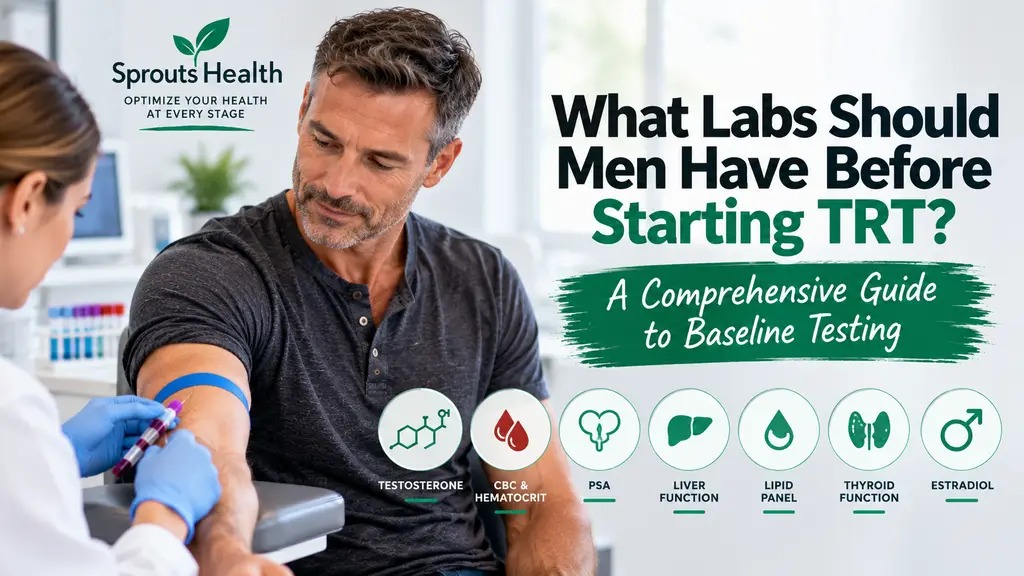
What labs before TRT should men have checked? Before starting testosterone replacement therapy, a comprehensive evaluation should include more than a single testosterone measurement. Understanding total and free testosterone, SHBG, blood counts, and other relevant health markers can help determine whether treatment is appropriate and establish a baseline for safe monitoring.
You’ve been experiencing low libido, fatigue, declining strength, poor recovery or other symptoms that make you wonder whether testosterone is part of the problem.
Maybe you’ve already had your testosterone checked.
What’s next?
Starting testosterone replacement therapy should involve more than checking one total testosterone level and writing a prescription.
What Labs Before TRT Are Most Important?
Before treatment, I want to answer several questions:
What does your total testosterone show?
What does your free testosterone show?
Does SHBG help explain the difference?
Why might your testosterone be low?
And is testosterone therapy appropriate and safe for you?
Testosterone Looks Normal, But You Don’t Feel Like Yourself?
A testosterone number is only part of the picture. Free testosterone, SHBG, symptoms, sleep, and metabolic health can all provide important context.
At Sprouts Health, we take a personalized approach to men’s hormone health and help you understand what your results actually mean.
Book Your Clarity Session →Personalized hormone care via telemedicine throughout Arizona
Here’s what a thoughtful evaluation may include.
1. Total Testosterone
Total testosterone remains an important starting point.
The AUA recommends using two separate early-morning total testosterone measurements when diagnosing testosterone deficiency and uses <300 ng/dL as a reasonable diagnostic cutoff. American Urological Association
The Endocrine Society likewise recommends repeat morning fasting testing and emphasizes symptoms plus consistently low testosterone rather than diagnosing hypogonadism from one result. Endocrine Society
But I don’t believe total testosterone should necessarily be the end of the evaluation.
A total testosterone level doesn’t always tell the whole story. Learn more about whether a testosterone level of 300–400 is actually low.
A man can have a total testosterone result that looks acceptable while the rest of his hormonal picture deserves a closer look.
2. Free Testosterone
Free testosterone can be especially useful when total testosterone and symptoms don’t seem to match.
Imagine a man with:
Total testosterone: 500 ng/dL
If he’s symptomatic, I don’t necessarily stop there.
Depending on the situation, I may want to know:
What is his free testosterone?
And:
What is his SHBG?
The Endocrine Society recognizes the role of free testosterone when indicated, and recent Endocrine Society commentary specifically notes using calculated free testosterone when SHBG is abnormal. Endocrine Society
Free testosterone shouldn’t be interpreted without knowing the units, methodology and laboratory reference range.
There isn’t one universal “optimal free T” number that applies to every laboratory and every man.
3. SHBG
Sex hormone-binding globulin—or SHBG—helps us understand the relationship between total and free testosterone.
SHBG binds testosterone in the bloodstream.
If SHBG is relatively high, a man may have an apparently adequate total testosterone but less free testosterone than expected.
If SHBG is low, the opposite pattern can occur.
Conditions associated with altered SHBG include obesity, diabetes, thyroid disorders, liver disease, aging and certain medications or hormones. Endocrine Society
That’s why I particularly like having SHBG available when the total testosterone doesn’t seem to match how the patient feels.
4. LH
Once we identify a potentially abnormal testosterone pattern, the next question is:
Why?
Luteinizing hormone (LH) is produced by the pituitary and signals the testes to produce testosterone.
Low testosterone accompanied by elevated LH suggests a different physiological problem than low testosterone accompanied by low or inappropriately normal LH.
This helps distinguish between:
Primary hypogonadism — primarily a testicular problem.
and
Secondary hypogonadism — inadequate hypothalamic/pituitary signaling.
The Endocrine Society recommends measuring LH and FSH in men with confirmed hypogonadism to distinguish these patterns. Endocrine Society
5. FSH
Follicle-stimulating hormone is particularly relevant when fertility is part of the picture.
FSH plays an important role in sperm production.
And this is something every man considering testosterone should understand:
External testosterone can suppress sperm production.
If a man wants biological children now—or may want them later—fertility should be discussed before TRT begins.
That may change the evaluation and treatment strategy.
6. Prolactin — When Indicated
Prolactin isn’t necessarily required in every man considering testosterone.
But it becomes particularly important when testosterone is low and LH is low or inappropriately normal.
Elevated prolactin can interfere with normal hypothalamic-pituitary signaling and contribute to low testosterone.
Depending on the degree of elevation and clinical picture, further pituitary evaluation may be necessary.
Again:
The objective isn’t merely to replace testosterone.
It’s to understand why the hormonal system isn’t functioning normally.
7. CBC, Hemoglobin and Hematocrit
This is an important safety measurement before TRT.
Testosterone can stimulate red blood cell production, and hematocrit can rise during treatment.
That’s why I want a baseline CBC, including hemoglobin and hematocrit, before treatment and continued monitoring afterward.
Elevated hematocrit isn’t something to ignore simply because a man feels better on testosterone.
Monitoring is part of responsible testosterone therapy.
8. PSA and Prostate Assessment
Depending on age, history and individual risk, prostate evaluation may also be appropriate before starting TRT.
The Endocrine Society recommends discussing prostate risk assessment and monitoring with appropriate men considering testosterone therapy. Endocrine Society
An abnormal PSA doesn’t automatically mean prostate cancer.
But it may require further evaluation before treatment begins.
9. Estradiol Matters in Men Too
This is one area of testosterone care where I think the conversation needs more nuance.
Estradiol isn’t exclusively a female hormone. Men need estradiol too.
Men naturally produce estradiol largely through conversion of testosterone via the aromatase enzyme.
As testosterone increases during TRT, estradiol may increase as well.
That does not automatically mean the estradiol needs to be lowered.
Estradiol contributes to important aspects of male physiology, including bone health and sexual function.
WorldLink Medical’s educational literature similarly emphasizes that estradiol has important physiological roles in men rather than treating estrogen simply as an unwanted hormone. World Link Medical
So I don’t believe in treating an estradiol number simply because it increased after starting testosterone.
The question is:
Is the patient having a clinically meaningful problem?
The number should be interpreted in the context of symptoms, testosterone levels, treatment and the overall hormonal picture.
Fatigue, low libido, and changes in muscle mass can have several causes. Learn more about the common symptoms of low testosterone in men and when further testing may be appropriate.
What About Aromatase Inhibitors?
Aromatase inhibitors decrease conversion of testosterone to estradiol.
They have legitimate uses in selected clinical situations.
But that’s very different from automatically prescribing an aromatase inhibitor because estradiol increased during TRT.
I do not routinely try to suppress estradiol in men simply to reach an arbitrary laboratory target.
Driving estradiol unnecessarily low can be counterproductive because estradiol has important physiological functions in men.
The goal isn’t:
“Keep estrogen as low as possible.”
The goal is healthy hormonal physiology.
Should Estradiol Be Checked Before TRT?
Not necessarily in every man.
Testing should answer a clinical question rather than simply creating the largest possible hormone panel.
Estradiol may be particularly useful when there are relevant symptoms, breast symptoms or gynecomastia, or when monitoring a particular clinical situation.
And when estradiol is measured, the result should be interpreted thoughtfully rather than automatically triggering treatment.
10. Metabolic Health
This is where my evaluation often extends beyond a basic TRT checklist.
A man may come to me because of:
Fatigue.
Weight gain.
Loss of muscle.
Poor recovery.
Low motivation.
He assumes it’s testosterone.
Sometimes testosterone is part of the picture.
Sometimes there’s more going on.
Depending on history and symptoms, I may also evaluate:
Fasting glucose and/or hemoglobin A1c
Lipid profile
Liver and kidney function
Blood pressure and cardiometabolic risk
Obesity and metabolic dysfunction are closely associated with testosterone levels, and current Endocrine Society guidance emphasizes addressing reversible contributors rather than automatically treating every low result with TRT.
When deciding what labs before TRT are appropriate, clinicians should consider symptoms, medical history, cardiovascular risk factors, and findings from the initial hormone evaluation.
11. Thyroid Testing — When Clinically Relevant
Fatigue, difficulty maintaining muscle, weight changes, mood changes and sexual symptoms aren’t unique to testosterone deficiency.
Thyroid dysfunction can produce overlapping symptoms and can also affect SHBG.
So when the history suggests it, thyroid evaluation can be an important part of understanding the bigger hormonal picture.
This doesn’t mean every man needs an enormous thyroid panel.
Testing should be driven by the clinical picture.
Don’t Forget Sleep Apnea
This isn’t a blood test, but it deserves a place in the evaluation.
If a man:
Snores heavily
Wakes unrefreshed
Has witnessed pauses in breathing
Experiences excessive daytime sleepiness
Has resistant hypertension
Or has other risk factors for obstructive sleep apnea
I want to know.
Untreated severe obstructive sleep apnea is among the conditions for which the Endocrine Society recommends against initiating testosterone therapy. Endocrine Society
And sleep apnea itself can cause:
Fatigue.
Poor concentration.
Low energy.
Poor exercise recovery.
Metabolic dysfunction.
Those symptoms can easily be mistaken for “low T.”
A Practical Pre-TRT Evaluation
There isn’t one identical panel every man needs.
Depending on symptoms, history and previous results, I may consider:
Total testosterone — usually repeat testing
Free testosterone when appropriate
SHBG
LH
FSH
Prolactin when indicated
CBC with hemoglobin and hematocrit
PSA/prostate assessment when appropriate
Estradiol when clinically useful
Metabolic testing
Thyroid testing when clinically relevant
But labs aren’t the entire evaluation.
I also want to know about:
Sleep.
Medications.
Weight changes.
Metabolic health.
Cardiovascular history.
Fertility goals.
Sexual function.
Exercise.
And what actually changed.
What If Your Total Testosterone Is “Normal”?
This is where I don’t automatically stop investigating.
If your total testosterone is 500, but you have significant symptoms, that doesn’t prove testosterone is the problem.
But it doesn’t necessarily prove testosterone isn’t involved either.
That’s where free testosterone, SHBG, repeat testing and the broader clinical picture become useful.
On the other hand, if testosterone testing looks appropriate and your hormonal evaluation doesn’t support androgen deficiency, that information is useful too.
Maybe poor sleep is driving the fatigue.
Maybe thyroid dysfunction deserves attention.
Maybe medication is affecting sexual function.
Maybe metabolic health is contributing.
The purpose of the evaluation isn’t to find a reason to prescribe testosterone.
It’s to figure out why you don’t feel well.
If You Start TRT, Testing Doesn’t Stop
Starting testosterone isn’t the end of the process.
It’s the beginning of monitoring.
Follow-up should ask:
Are your symptoms actually improving?
What are your total and free testosterone doing?
Is hematocrit increasing?
Are there adverse effects?
Is prostate monitoring appropriate?
How are you actually feeling?
Current Endocrine Society guidance recommends follow-up after testosterone initiation to evaluate treatment response, adverse effects and adherence. Endocrine Society
The goal isn’t simply:
“Get testosterone as high as possible.”
And it isn’t:
“Make every hormone land on one predetermined optimal number.”
The goal is to use laboratory information alongside the patient’s clinical response to guide safe, individualized treatment.
The Bottom Line
Before starting TRT, I don’t think the evaluation should stop at:
“What’s your total testosterone?”
I want to understand:
Total testosterone.
Free testosterone when appropriate.
SHBG.
LH and FSH.
Why testosterone may be low.
Fertility goals.
Hematocrit and relevant safety markers.
Metabolic health.
Sleep.
And the man’s symptoms.
And if estradiol rises during treatment, I don’t automatically view that as a problem that needs to be suppressed.
Understanding what labs before TRT are necessary helps establish an individualized baseline, identify potential safety concerns, and guide appropriate follow-up monitoring.
Good testosterone care isn’t about treating one laboratory number—or chasing a collection of “optimal” numbers. It’s about understanding the entire hormonal picture and treating the individual man.
Clinical References
- American Urological Association (AUA) — Testosterone Deficiency Guideline
- Endocrine Society — Testosterone Therapy Clinical Practice Guideline
Frequently Asked Questions About Labs Before TRT
What blood tests should men have before starting testosterone replacement therapy?
Before TRT, evaluation generally includes two separate early-morning total testosterone measurements, a complete blood count (CBC) with hematocrit, and testing to identify the cause of testosterone deficiency. Depending on age, symptoms, medical history, and initial results, additional testing may include free testosterone, SHBG, LH, FSH, prolactin, PSA, and metabolic assessments. Not every man needs every test.
Why should testosterone be tested twice before starting TRT?
Testosterone levels fluctuate naturally and can be affected by sleep, illness, medications, and other factors. Major clinical guidelines recommend confirming low testosterone with measurements on two separate mornings, together with compatible symptoms and clinical findings, before diagnosing testosterone deficiency.
Should free testosterone and SHBG be checked before TRT?
Free testosterone and sex hormone-binding globulin (SHBG) can be particularly helpful when total testosterone is borderline or when conditions affecting SHBG may make total testosterone misleading. Free testosterone should be measured using a reliable method or calculated from appropriate laboratory measurements. It is interpreted alongside symptoms and total testosterone rather than as a stand-alone reason to prescribe TRT.
Why is hematocrit important before testosterone therapy?
Testosterone therapy can increase red blood cell production and raise hematocrit. A baseline CBC helps identify elevated hematocrit or other abnormalities before treatment. Hematocrit should also be monitored during therapy because excessive elevation may require treatment adjustments and evaluation for contributing factors such as sleep apnea.
Does every man need a PSA test before starting TRT?
Not necessarily. PSA testing before TRT depends on age, prostate cancer risk, medical history, and shared decision-making. Guidelines recommend prostate evaluation in appropriate patients before treatment, with follow-up monitoring based on individual risk and clinical circumstances.
Should estradiol, thyroid, and metabolic labs be checked before TRT?
These tests can be useful when clinically indicated, but they are not universally required for every patient. Estradiol may be relevant in men with gynecomastia or breast symptoms. Thyroid testing can help investigate overlapping symptoms, while glucose or A1c, lipids, and other metabolic markers may help assess overall cardiometabolic health. The testing plan should be individualized.
Men’s Hormone Health | Sprouts Health
Your Health Deserves More Than a Lab Number.
Low energy, reduced libido, declining strength, or changes in body composition?
Work with Zhanna Tarjeft, FNP-BC, to explore your symptoms, understand your hormone results, and identify appropriate next steps through individualized care.
Book Your Clarity Session →Arizona Telemedicine | Personalized Hormone Care