
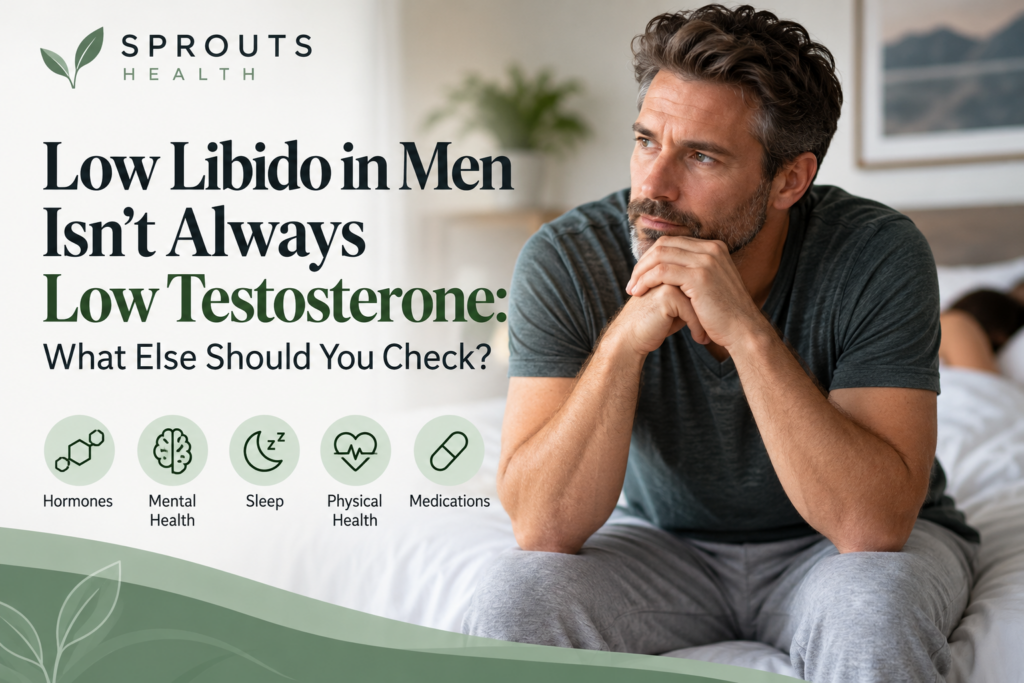
Low libido in men is often blamed on low testosterone, but sexual desire is influenced by much more than one hormone. Poor sleep, chronic stress, certain medications, relationship concerns, thyroid dysfunction, depression, and metabolic health can all contribute to reduced interest in sex. Understanding these factors is essential before assuming testosterone replacement therapy is the answer.
Your sex drive isn’t what it used to be.
Maybe you rarely think about sex anymore. Maybe your interest is there occasionally, but it’s unpredictable. Or perhaps you’ve noticed changes in morning erections, energy, motivation and overall sense of well-being at the same time.
The obvious question is:
“Is my testosterone low?”
It might be.
Testosterone plays an important role in male sexual desire, and declining libido is one of the symptoms that deserves attention when evaluating possible testosterone deficiency.
But here’s the part that often gets missed:
Low libido isn’t a diagnosis—and testosterone isn’t the only hormone or health factor involved.
Sleep, metabolic health, medications, thyroid function, prolactin, estradiol, relationship and psychological factors, chronic illness and other issues can all influence sexual desire.
So instead of simply asking, “How do we raise testosterone?”, I prefer to start with a different question:
“Why did your libido change?”
Is Low Libido a Sign of Low Testosterone?
It can be.
Sexual symptoms are among the more relevant symptoms when evaluating men for testosterone deficiency.
A man may notice:
- Less interest in sex
- Fewer sexual thoughts
- Fewer spontaneous or morning erections
- Changes in erectile function
- Reduced sexual satisfaction
- A general decline in sexual motivation
But low libido alone doesn’t establish testosterone deficiency.
The Endocrine Society recommends diagnosing hypogonadism when men have compatible symptoms or signs and consistently low testosterone concentrations, rather than treating symptoms alone.
That’s an important distinction.
Low libido gives us a reason to investigate testosterone. It doesn’t automatically give us a reason to prescribe it.
What If Your Total Testosterone Is “Normal”?
This is where I think men are sometimes dismissed too quickly.
Imagine your total testosterone is:
510 ng/dL.
You’re told:
“Your testosterone is normal, so hormones aren’t the problem.”
But you’re experiencing a significant decline in libido, fewer morning erections, fatigue and changes in strength or recovery.
I wouldn’t necessarily stop the evaluation there.
Total testosterone is important, but it doesn’t always tell us everything about androgen availability.
Depending on the clinical picture, I may also consider:
Free testosterone
SHBG
Repeat testosterone testing
LH and FSH
Prolactin when indicated
Estradiol when clinically relevant
A man can have an apparently adequate total testosterone while his free testosterone tells a different story, particularly when SHBG is altered.
That doesn’t automatically mean he needs TRT.
It means “your total testosterone is normal” may not always be the end of the evaluation.
Testosterone Looks Normal, But You Don’t Feel Like Yourself?
A testosterone number is only part of the picture. Free testosterone, SHBG, symptoms, sleep, and metabolic health can all provide important context.
At Sprouts Health, we take a personalized approach to men’s hormone health and help you understand what your results actually mean.
Book Your Clarity Session →Personalized hormone care via telemedicine throughout Arizona
Free Testosterone Can Add Important Information
Most testosterone circulating in the bloodstream is bound to proteins, particularly SHBG and albumin.
Only a small fraction circulates as free testosterone.
This means two men with the same total testosterone can have different free testosterone levels.
When symptoms and total testosterone don’t seem to match, free testosterone and SHBG may provide additional context.
Major endocrine guidance recognizes a role for assessing free testosterone when indicated, particularly when total testosterone is borderline or when SHBG may be altered.
Understanding the difference between total and free testosterone can be especially helpful when evaluating persistent symptoms. Two men with similar total testosterone levels may have different free testosterone levels because of variations in SHBG. I explain this in greater detail in my article, Why One Testosterone Test Isn’t Enough: Total T, Free T & the Bigger Picture.
But just as I don’t diagnose a man from total testosterone alone, I don’t diagnose him from one free-testosterone number either.
Symptoms + total T + free T + SHBG + clinical context tell us much more than one number by itself.
Low libido in men can sometimes be associated with testosterone deficiency, but a single total testosterone result doesn’t always provide the complete picture. Symptoms, free testosterone, SHBG, and other health factors may warrant further evaluation. If you’ve been told your testosterone is normal but still don’t feel like yourself, read my article: Is a Testosterone Level of 300–400 Actually Low?
Low Libido in Men: What Should You Check Beyond Testosterone?
According to the Endocrine Society’s Clinical Practice Guideline on Testosterone Therapy, testosterone deficiency should be diagnosed only when men have compatible symptoms and consistently low testosterone concentrations confirmed through appropriate testing. This reinforces why low libido should not automatically lead to a testosterone prescription without a comprehensive evaluation.
Low libido is often multifactorial. As explained by Mayo Clinic’s overview of low sex drive in men, sexual desire can be influenced by psychological factors, relationship concerns, medications, and underlying medical conditions. Identifying and addressing these contributors may be just as important as evaluating hormone levels.
What Else Can Cause Low Libido in Men?
Quite a lot.
And this is why simply increasing testosterone isn’t always the answer.
1. Poor Sleep and Sleep Apnea
Sleep is one of the first things I want to know about.
Does he snore?
Does he wake up feeling unrefreshed?
Does his partner notice pauses in his breathing?
Is he exhausted during the day despite spending enough time in bed?
Obstructive sleep apnea can contribute to fatigue, impaired quality of life and sexual dysfunction. It can also coexist with obesity and other metabolic conditions associated with lower testosterone.
Untreated severe obstructive sleep apnea is also among the conditions the Endocrine Society lists as a reason not to initiate testosterone therapy until appropriately addressed.
Sometimes the man asking for more testosterone actually needs a sleep evaluation.
2. Medications
Several medications can affect libido or sexual function.
Depending on the individual, these may include certain:
Antidepressants
Opioids
Blood-pressure medications
Finasteride or other 5-alpha-reductase inhibitors
Other medications affecting hormonal or neurologic function
That doesn’t mean you should stop a prescribed medication because you think it’s affecting your libido.
It means medication history belongs in the evaluation.
If sexual symptoms started soon after a medication was introduced or changed, that’s useful information.
3. Prolactin
Prolactin isn’t just a hormone relevant to women.
Elevated prolactin in men can suppress normal hypothalamic-pituitary signaling and contribute to low testosterone and sexual dysfunction.
The AUA recommends measuring prolactin in men with low testosterone accompanied by low or low-normal LH.
Significantly elevated prolactin may require further investigation rather than simply treating the testosterone result.
This is another example of why I want to know why testosterone is low.
4. Thyroid Function
Thyroid dysfunction can overlap with many symptoms men attribute to testosterone:
Fatigue
Mood changes
Weight changes
Changes in sexual function
Changes in energy and motivation
Thyroid status can also influence SHBG, which can affect the relationship between total and free testosterone.
I don’t believe every man with low libido needs an enormous thyroid panel.
But when symptoms or history point in that direction, thyroid evaluation can be relevant.
5. Metabolic Health
Hormonal and metabolic health are closely connected.
Obesity, insulin resistance, diabetes and cardiovascular disease can overlap with both low testosterone and sexual dysfunction.
This becomes especially important when a man says:
“My libido is down, I’ve gained 25 pounds around my abdomen, I’m exhausted and my workouts aren’t working anymore.”
That deserves a broader evaluation than simply checking testosterone.
Sometimes testosterone is part of the picture.
Sometimes improving metabolic health changes the hormonal picture too.
6. Stress, Mood and Relationship Factors
Sexual desire happens in a human being—not in a laboratory report.
Chronic stress, anxiety, depression, relationship conflict, major life changes and psychological factors can all affect libido.
That doesn’t mean:
“It’s all in your head.”
And it doesn’t mean testosterone shouldn’t be evaluated.
It means sexual desire is influenced by the brain, hormones, physical health, medications and life circumstances simultaneously.
Sometimes more than one factor is contributing.
What About Estradiol?
This is an area where male hormone care can become unnecessarily aggressive.
Men need estradiol.
Men produce estradiol primarily through the conversion of testosterone by the aromatase enzyme, and estradiol contributes to male physiology, including bone and sexual function.
So I don’t view estradiol as a hormone that automatically needs to be pushed down.
In fact, research manipulating testosterone and estradiol in men has demonstrated that both androgen and estrogen deficiency can contribute to changes in sexual function.
That matters when treating men with testosterone.
If estradiol increases during TRT, the number alone doesn’t automatically mean something is wrong.
And routinely suppressing estradiol simply to achieve an arbitrary target can create problems of its own.
Does High Estradiol Cause Low Libido?
This is where I’d be cautious about oversimplification.
It’s very common online to see:
Low libido on TRT = estrogen is too high.
Then an aromatase inhibitor gets added.
But libido is much more complicated than that.
Rather than automatically treating an estradiol result, I want to know:
What symptoms is the man actually experiencing?
What are his testosterone and free testosterone levels?
What has changed since treatment started?
What medications is he taking?
What is happening with sleep and metabolic health?
And does the estradiol result actually make sense in that context?
A laboratory number should not automatically trigger another medication.
What About Aromatase Inhibitors?
Aromatase inhibitors reduce conversion of testosterone into estradiol.
They have legitimate clinical uses in selected circumstances.
But that’s different from automatically giving an aromatase inhibitor to every man whose estradiol increases on TRT.
My goal isn’t:
“Keep male estrogen as low as possible.”
It’s to maintain healthy hormonal physiology while addressing the man’s actual symptoms and treatment goals.
Because testosterone and estradiol both matter.
Erectile Dysfunction and Low Libido Aren’t the Same Thing
This distinction is important.
Libido is desire.
Erectile function is the ability to achieve and maintain an erection.
They influence one another, but they aren’t interchangeable.
A man can have:
Strong libido + erectile dysfunction
or
Low libido + normal erections.
Erectile dysfunction can involve vascular disease, diabetes, neurologic conditions, medications, psychological factors and other causes in addition to hormones.
In fact, erectile dysfunction can sometimes be an early clue to underlying cardiovascular disease.
So if the primary complaint is erectile dysfunction rather than loss of sexual desire, the evaluation shouldn’t stop with testosterone.
What If You’re Already on TRT but Your Libido Is Still Low?
This is another situation where simply increasing the testosterone dose isn’t always the answer.
I’d want to know:
Did libido ever improve after starting TRT?
What are total and free testosterone now?
What is SHBG doing?
Are there medication effects?
How is sleep?
Has erectile function changed?
Are there metabolic or cardiovascular issues?
Is estradiol being unnecessarily suppressed?
Are stress, mood or relationship factors contributing?
And importantly:
Are we treating symptoms—or simply chasing hormone numbers?
More testosterone isn’t automatically better.
Neither is less estradiol.
The goal is to understand why the patient still has symptoms.
What Labs Might Be Useful for Low Libido?
Testing should be individualized, but depending on the history, evaluation may include:
Total testosterone
Repeat morning testosterone
Free testosterone when appropriate
SHBG
LH and FSH
Prolactin when indicated
Estradiol when clinically relevant
Thyroid testing when appropriate
CBC
Metabolic markers
But labs are only one part of the workup.
I also want to know about:
Sleep.
Medications.
Alcohol and substance use.
Weight changes.
Exercise.
Stress.
Mood.
Relationship factors.
Erectile function.
Fertility goals.
Because libido doesn’t live inside a testosterone result.
The Bottom Line
Low libido can absolutely be a symptom of testosterone deficiency.
But low libido does not automatically mean low testosterone—and low testosterone isn’t the only reason a man’s sex drive can change.
If your total testosterone looks “normal” but you’ve experienced a significant change in sexual desire, the evaluation doesn’t necessarily have to stop there.
Free testosterone and SHBG may provide additional information.
Sleep, metabolic health, medications, thyroid function, prolactin and other factors may matter too.
And if you’re already taking testosterone but your libido hasn’t improved, simply raising the dose—or automatically suppressing estradiol—isn’t necessarily the solution.
Good hormone care asks a better question than “How do we raise testosterone?”
It asks:
“Why did this man’s libido change?”
And then we work from there.
Frequently Asked Questions About Low Libido in Men
Can a man have low libido with normal testosterone levels?
Yes. Sexual desire is influenced by physical health, emotional well-being, sleep, medications, relationship factors, and hormones. Men can experience reduced libido even when testosterone levels fall within the laboratory reference range. A comprehensive evaluation can help identify contributing factors rather than assuming testosterone deficiency is the cause.
What are the most common causes of low libido in men besides testosterone?
Common contributors include chronic stress, depression, anxiety, poor sleep, obstructive sleep apnea, certain medications, relationship difficulties, chronic medical conditions, and excessive alcohol use. Thyroid disorders and elevated prolactin can also contribute in some cases. Often, more than one factor is involved.
Can stress and poor sleep lower a man’s sex drive?
Yes. Chronic stress can interfere with sexual desire through psychological and physiological pathways. Insufficient sleep and untreated sleep apnea may contribute to fatigue, mood changes, and altered testosterone regulation. Addressing sleep quality and stress can improve overall well-being and may help restore sexual interest.
Which blood tests should be checked for low libido in men?
Testing should be guided by symptoms and medical history. When testosterone deficiency is suspected, clinicians typically begin with early-morning total testosterone testing, repeated on a separate day if low. Free testosterone and SHBG may provide additional information when total testosterone is borderline or SHBG is abnormal. Thyroid function, prolactin, glucose or A1c, and other laboratory tests may be appropriate depending on the clinical picture.
Can antidepressants or other medications cause low libido?
Yes. Certain antidepressants, particularly selective serotonin reuptake inhibitors (SSRIs), can reduce sexual desire or affect sexual function. Some other medications, including opioids and certain hormonal treatments, may also contribute. Never discontinue prescribed medication without discussing alternatives or adjustments with the prescribing clinician.
Will testosterone replacement therapy improve libido if testosterone is normal?
Testosterone therapy may improve sexual desire in some men with confirmed testosterone deficiency, but benefits are less established when testosterone levels are normal. TRT is not a universal treatment for low libido and carries potential risks, including suppression of sperm production and elevated hematocrit. Treatment should focus on identifying the underlying causes and determining whether testosterone deficiency is genuinely present.
Men’s Hormone Health | Sprouts Health
Low Libido but Your Testosterone Was “Normal”?
Low energy, reduced libido, declining strength, or changes in body composition?
Work with Zhanna Tarjeft, FNP-BC, to explore your symptoms, understand your hormone results, and identify appropriate next steps through individualized care.
Book Your Clarity Session →Arizona Telemedicine | Personalized Hormone Care